Who we serve Transit
Websites for transit agencies.
Riders come to plan a trip, find out whether their bus is late and buy a pass.
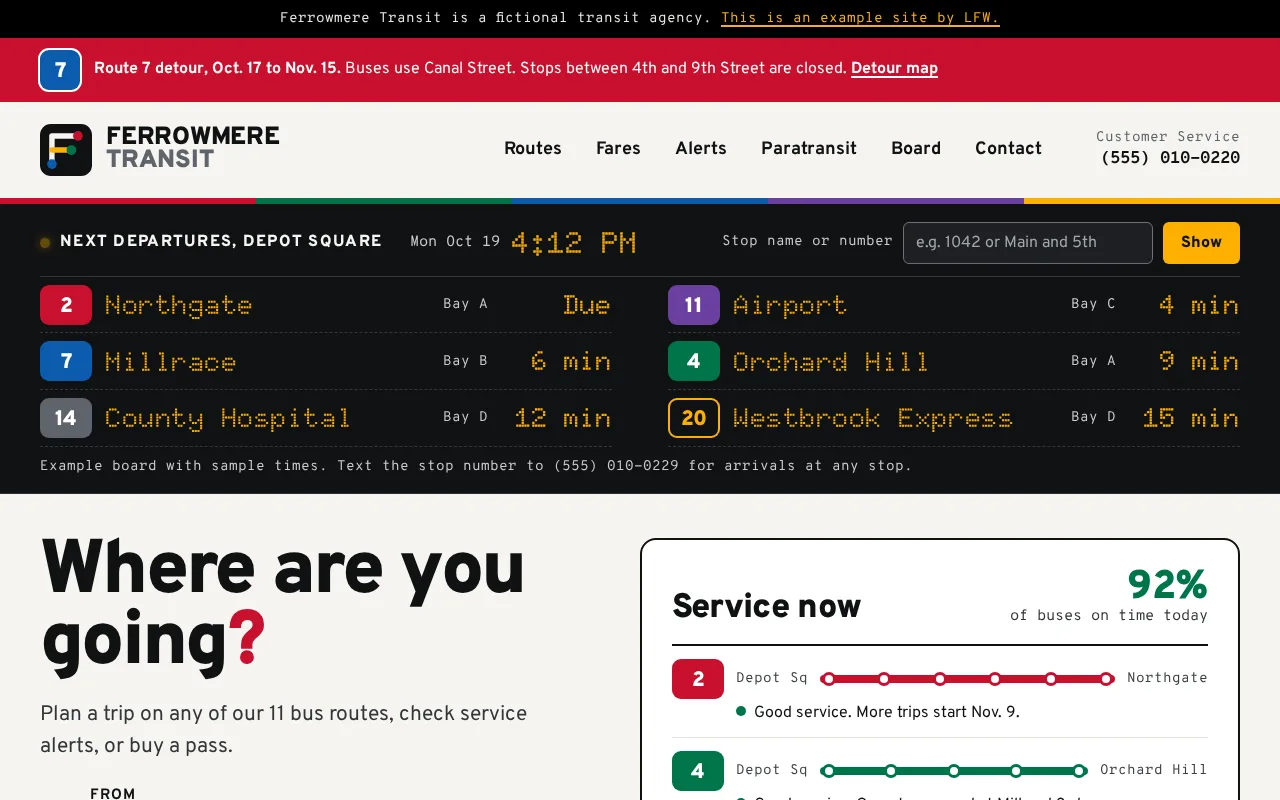
Ferrowmere Transit is fictional, an example site by LFW.
What residents come to do.
Most riders read the site at a stop, on a phone, in a hurry. Every page is built for that rider first.
Trips and schedules
A trip planner, route maps and timetables by line, built from the same GTFS feed that trip apps read.
Service alerts
Detours, delays and stop closures by route, posted by your staff in a minute, with email and text sign-ups.
Fares and passes
Fares, the online pass store, reduced-fare applications and where to buy in person.
The GTFS feed
A permanent address for your GTFS and GTFS Realtime files, with the license and a contact for developers.
Paratransit
Eligibility, the application, booking rules and the reservations line, in accessible formats.
Board and service changes
Agendas, public hearings on fare and service changes and your Title VI notice, where riders can find them.
What the law expects.
The rules that shape this kind of site, each linked to its source. We read them before we build, and your counsel has the last word.
-
ADA Title II web rule
State and local government websites must meet WCAG 2.1 Level AA, special districts included, and so must the documents posted on them.
- Public entities with a total population of 50,000 or more.
- Smaller public entities and special district governments.
Dates from the Department of Justice’s interim final rule of April 20, 2026 (Federal Register 2026-07663).
-
Title VI notice
An FTA recipient must, at a minimum, post a Title VI notice on the agency’s website and in public areas of its offices, telling riders their rights and how to file a complaint.
Source: FTA Circular 4702.1B, chapter III, section 5 (October 1, 2012)
-
Accessible information
A transit provider must make adequate information about its services available to riders with disabilities, through accessible formats and technology, so they can get information and schedule service.
Source: 49 CFR 37.167(f)
-
A public GTFS feed
Since report year 2023, the FTA requires National Transit Database reporters with fixed-route service to create and maintain a public GTFS dataset for it.
Source: FTA, NTD GTFS weblinks dataset
-
Open meetings
A public board posts notice and an agenda before it meets. Each state’s open-meetings law sets how far ahead and where, and the rules differ by state.
Source: Open Government Guide, Reporters Committee for Freedom of the Press
The example site.
Fictional, built by LFW, with the tasks above on its homepage.
-
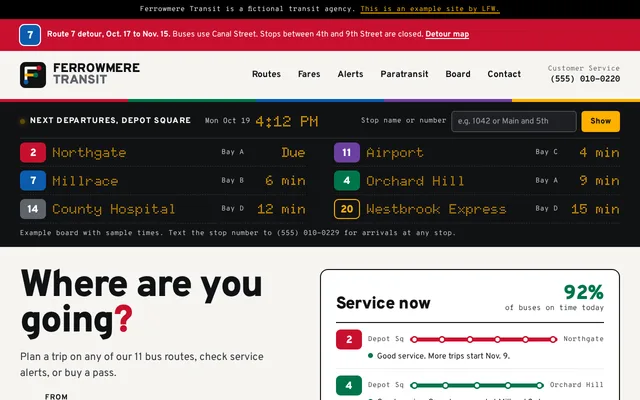
Ferrowmere Transit
Plan a trip, alerts, fares. Larger screenshot of Ferrowmere Transit
Built in.
LFW’s plugins for WordPress, free as each is released, chosen for what this kind of site does.
-
LFW Events Calendar
Built, not public yet
Public hearings on service changes and rider forums, with a calendar feed riders can subscribe to.
-
LFW Multilingual
Built, not public yet
Alerts, fares and the Title VI notice in the languages your riders speak.
-
LFW Search
Built, not public yet
Finds a route by number or a stop by street, from any page.
-
LFW Editorial Workflow
Built, not public yet
A schedule change goes live on its start date, after planning approves the page.
Courses for your staff.
Free in LFW Academy, self-paced. No account needed to start.
- Staff who post detours and suspensions Emergency Notices on Your Website About 90 minutes, in six lessons ending in a drill.
- Whoever writes service-change notices Writing for Residents About 45 minutes, in six short lessons.
- Staff who publish schedules and paratransit guides Accessible Content Basics About an hour, in seven lessons.
- Whoever holds the alert and social media logins Shared Accounts and Offboarding About 90 minutes, in six lessons with tasks on your own accounts.
Moving your transit agency off a platform.
What the agreements say about renewal, notice and your data, and what moving takes, step by step.
What it costs.
Prices are the same for every kind of public institution.
Care, $250 a month
Updates and security patches, off-site backups, uptime checked every minute and broken links found daily. Cancel any time.
A site you made, kept
A site you make yourself in your browser is already built, so there is no setup fee: Care starts the month you keep it.
Projects, at a fixed price
An accessibility audit and fix plan is $3,500; a district rebuild is $9,500. Larger scopes and RFPs are quoted in writing.
Make a site for your transit agency, then keep it.
Make one in your browser and look around first. When you want to keep it, all we need is your email.
Check your inbox. If the address can receive mail, a link is on its way.