Who we serve Regional councils
Websites for regional councils.
Member governments, residents and grant applicants come to read a plan, comment on a draft and find money for a local project.
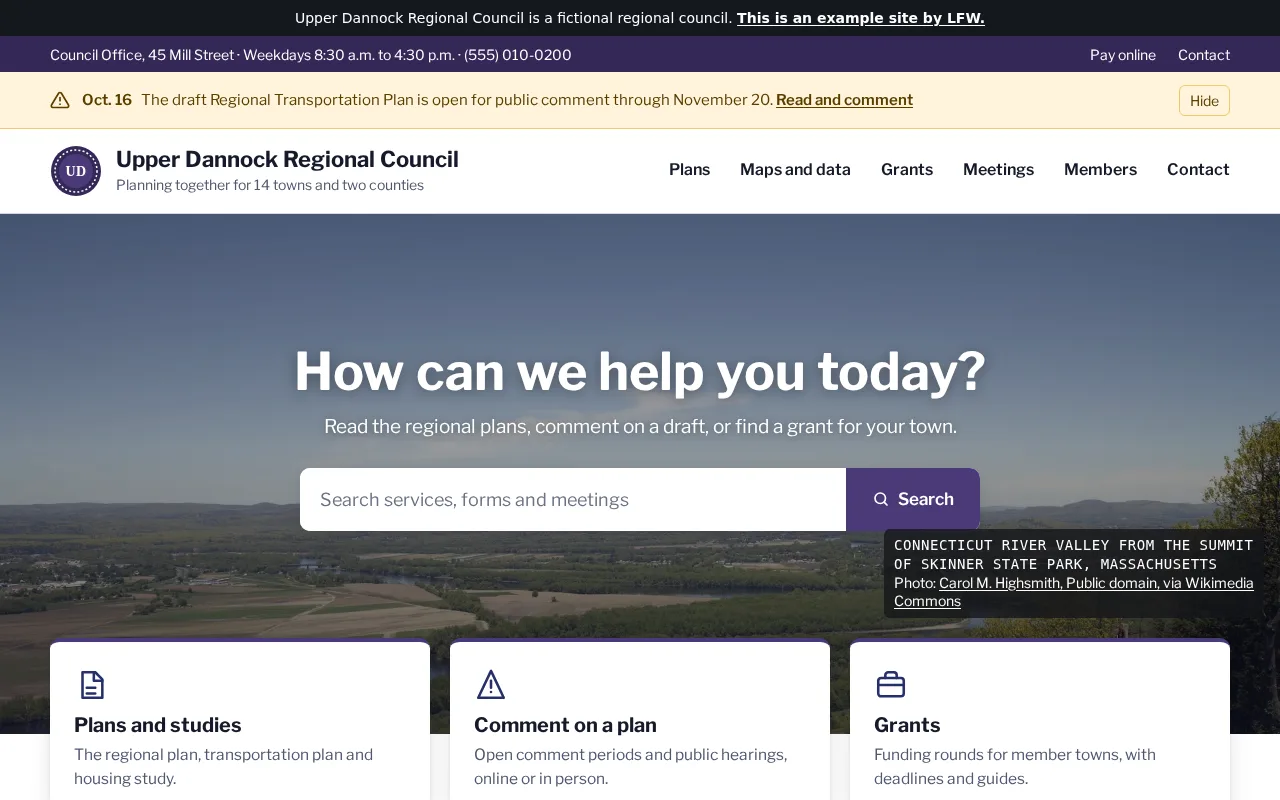
Upper Dannock Regional Council is fictional, an example site by LFW.
What residents come to do.
A council serves two audiences at once: the public and the towns that pay dues. The site has to answer both.
Plans and studies
The regional plan, the transportation plan and every study, each as a page with its summary first and the full document beside it.
Comment on a draft
An open comment period on the page itself, with the closing date, the hearing and what happens to each comment.
Grant rounds
Open rounds with deadlines, eligibility and guides, and past awards by town, so a small town’s clerk can tell in a minute whether to apply.
Maps and data
GIS maps, traffic counts and census tables by member community, downloadable in open formats.
Committees and hearings
The executive board, technical committees and hearings, with agendas, minutes and recordings by year.
Help for member towns
A request form that sends planning, mapping and grant-writing questions to the staff member who handles them.
What the law expects.
The rules that shape this kind of site, each linked to its source. We read them before we build, and your counsel has the last word.
-
ADA Title II web rule
State and local government websites must meet WCAG 2.1 Level AA, special districts included, and so must the documents posted on them.
- Public entities with a total population of 50,000 or more.
- Smaller public entities and special district governments.
Dates from the Department of Justice’s interim final rule of April 20, 2026 (Federal Register 2026-07663).
-
Metropolitan planning organizations
A council that is, or staffs, an MPO must make technical information and meeting notices available “in electronically accessible formats and means, such as the World Wide Web”, give at least 45 days of public comment before adopting its participation plan and post the approved plan on the web to the maximum extent practicable.
Source: 23 CFR 450.316(a)
-
Open meetings
A public board posts notice and an agenda before it meets. Each state’s open-meetings law sets how far ahead and where, and the rules differ by state.
Source: Open Government Guide, Reporters Committee for Freedom of the Press
The example site.
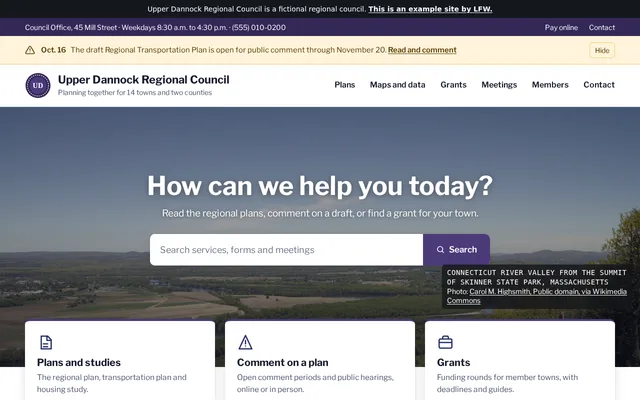
Fictional, built by LFW, with the tasks above on its homepage.
-
Upper Dannock Regional Council
Plans, public comment, grants. Larger screenshot of Upper Dannock Regional Council
Built in.
LFW’s plugins for WordPress, free as each is released, chosen for what this kind of site does.
-
LFW PDF Check
Open source on GitHub
Finds plans and studies that a screen reader cannot read, before a resident or a reviewer does.
-
LFW Events Calendar
Built, not public yet
Board and committee meetings, hearings and comment deadlines, with a calendar feed member towns can subscribe to.
-
LFW Editorial Workflow
Built, not public yet
A plan page changes only after the planner who owns it approves, with a record of who approved what.
-
LFW Search
Built, not public yet
Finds a study by town, topic or year across every plan the council has adopted.
Courses for your staff.
Free in LFW Academy, self-paced. No account needed to start.
- Planners who write summaries Writing for Residents About 45 minutes, in six short lessons.
- Staff who post plans and maps Accessible Content Basics About an hour, in seven lessons.
- The communications lead Running a Public Website Day to Day About 2 hours, in eight lessons with tasks on your own site.
- The office manager or executive director Shared Accounts and Offboarding About 90 minutes, in six lessons with tasks on your own accounts.
Moving your regional council off a platform.
What the agreements say about renewal, notice and your data, and what moving takes, step by step.
What it costs.
Prices are the same for every kind of public institution.
Care, $250 a month
Updates and security patches, off-site backups, uptime checked every minute and broken links found daily. Cancel any time.
A site you made, kept
A site you make yourself in your browser is already built, so there is no setup fee: Care starts the month you keep it.
Projects, at a fixed price
An accessibility audit and fix plan is $3,500; a district rebuild is $9,500. Larger scopes and RFPs are quoted in writing.
Make a site for your regional council, then keep it.
Make one in your browser and look around first. When you want to keep it, all we need is your email.
Check your inbox. If the address can receive mail, a link is on its way.