LFW Newborn Screener
Follow every baby from the first screen to the last result.
Hearing, bloodspot, CCHD and birth defects follow-up on one record per baby.
- A result that needs action starts a care path
- Birth facilities see their own missing screens
- The 1-3-6 numbers come from the record
For state newborn screening programs · working demo, not in production
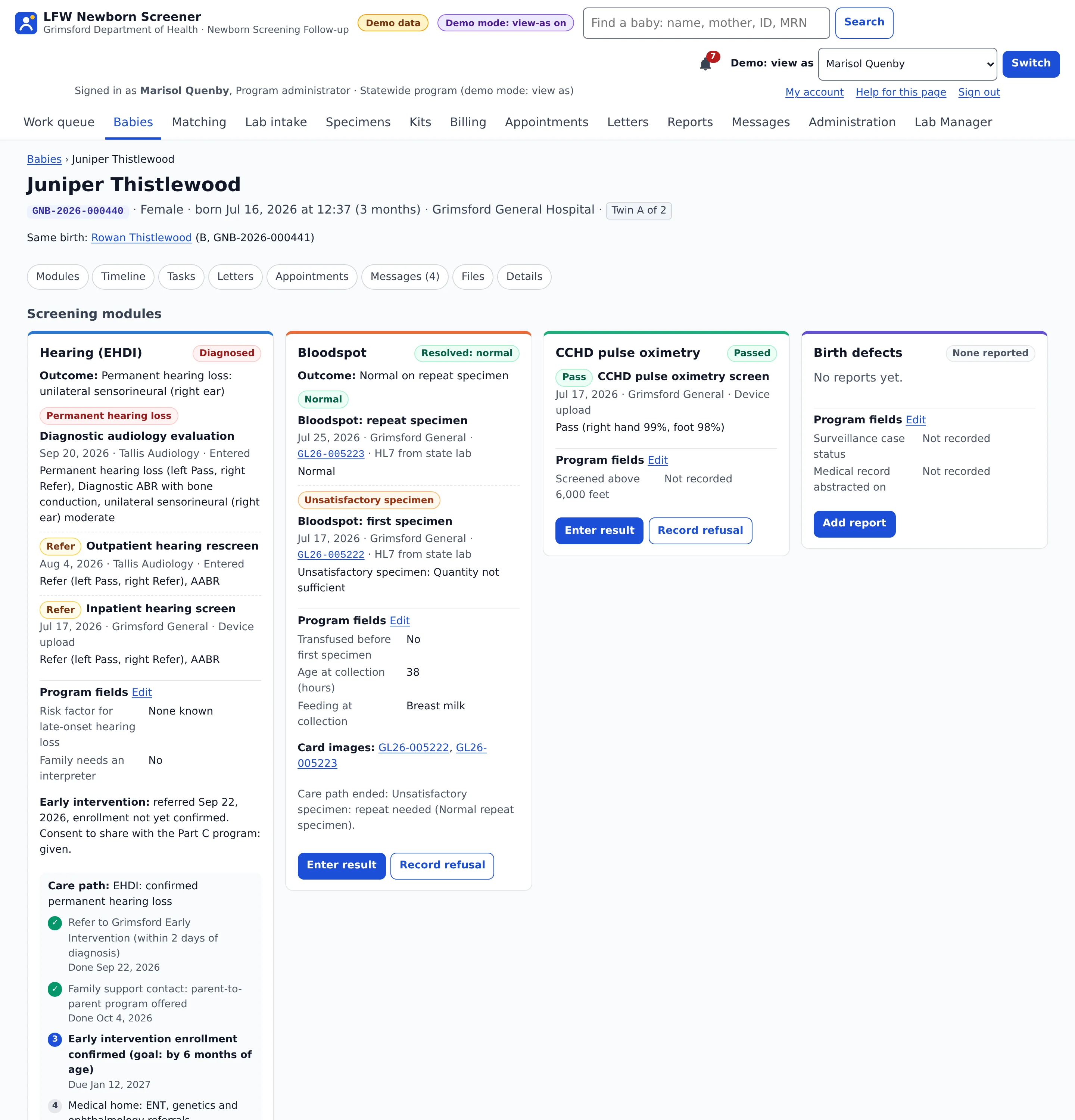
See it with sample data.
Screens from the working demo, for the fictional Grimsford Department of Health, its birth facilities and its laboratory. Every baby, family, provider and result is invented, and each screen carries a Demo data label.

Enlarge to view the full screenshot.
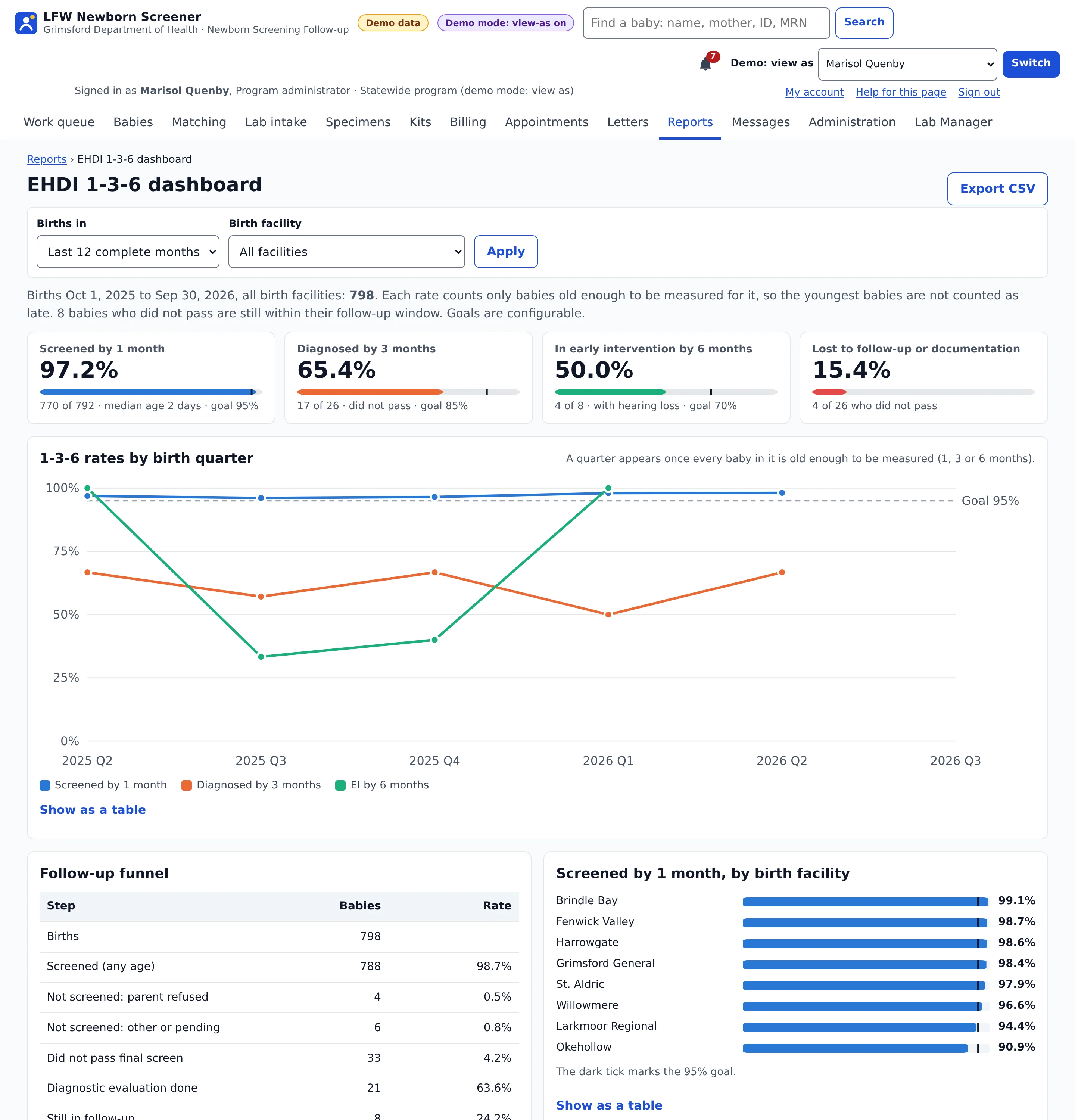

Enlarge to view the full screenshot.
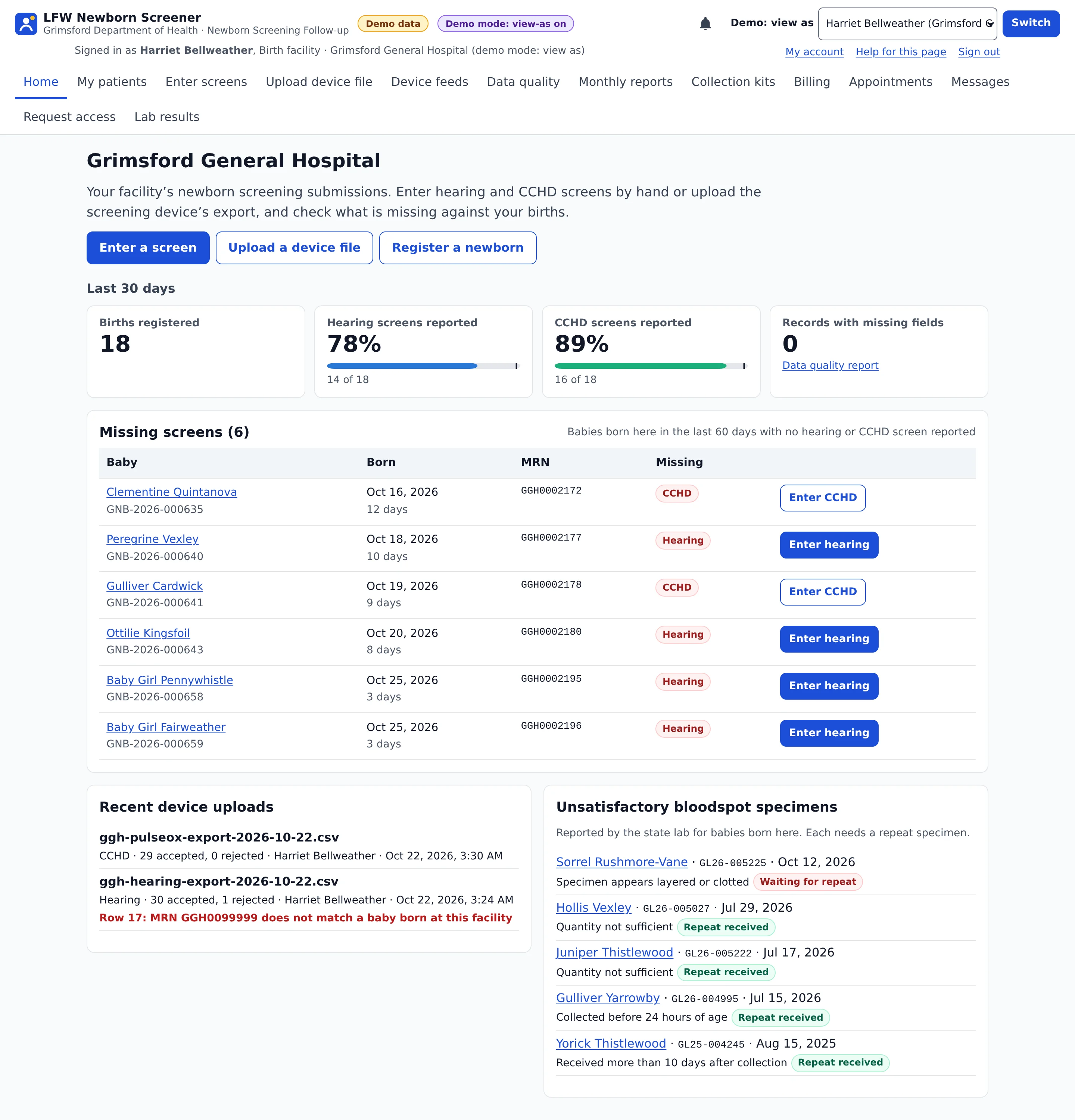

Enlarge to view the full screenshot.
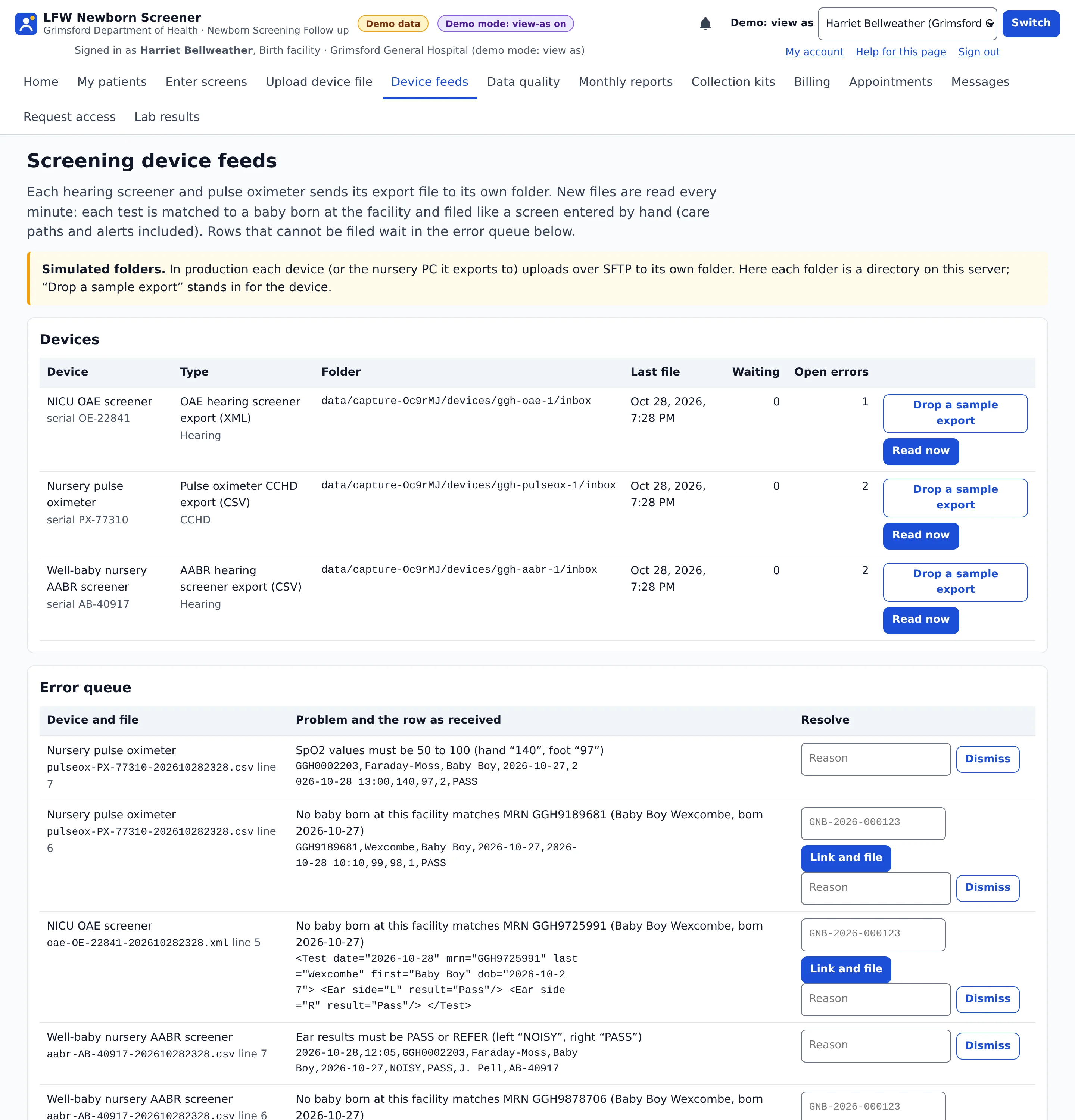

Enlarge to view the full screenshot.
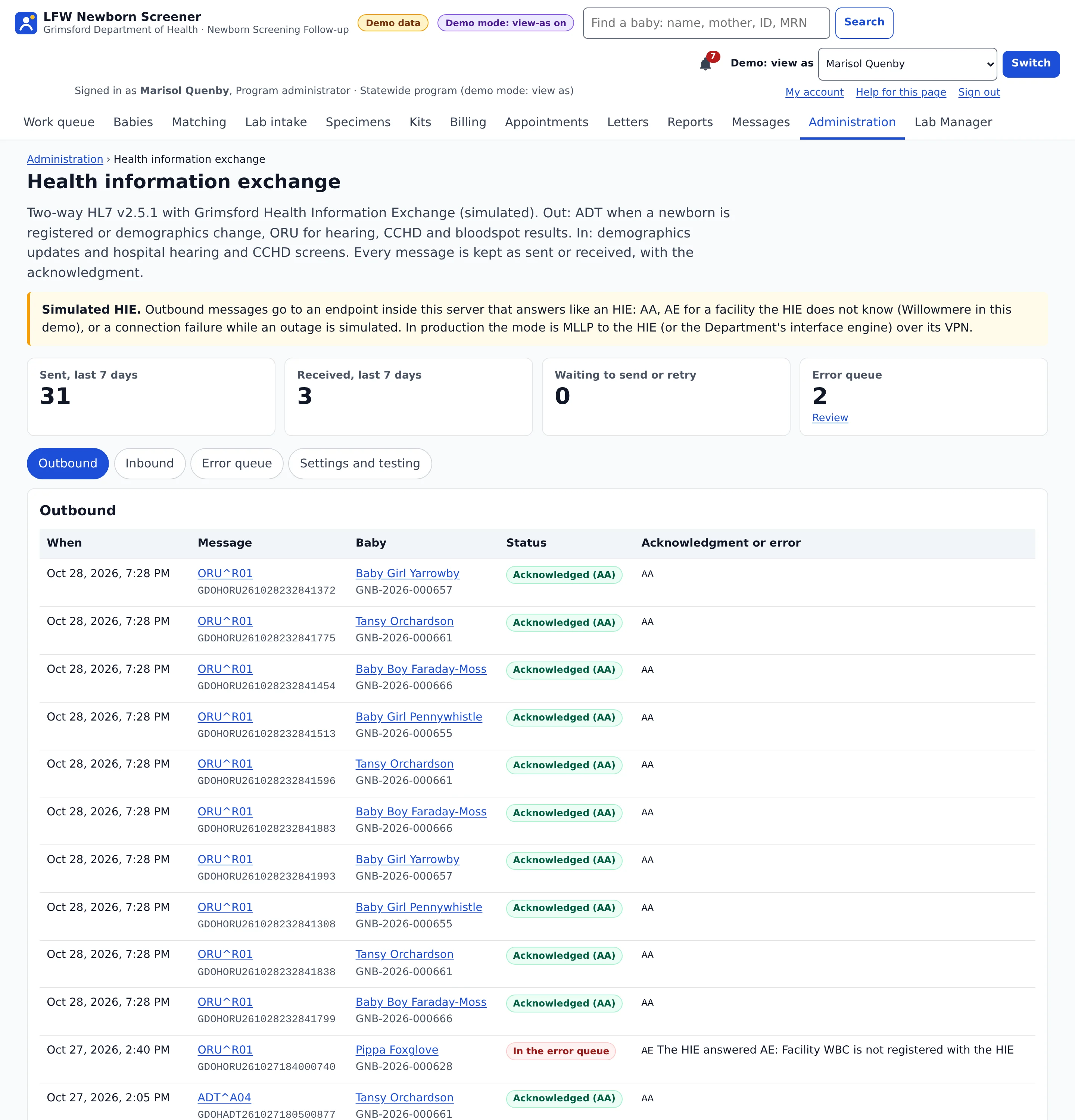

Enlarge to view the full screenshot.
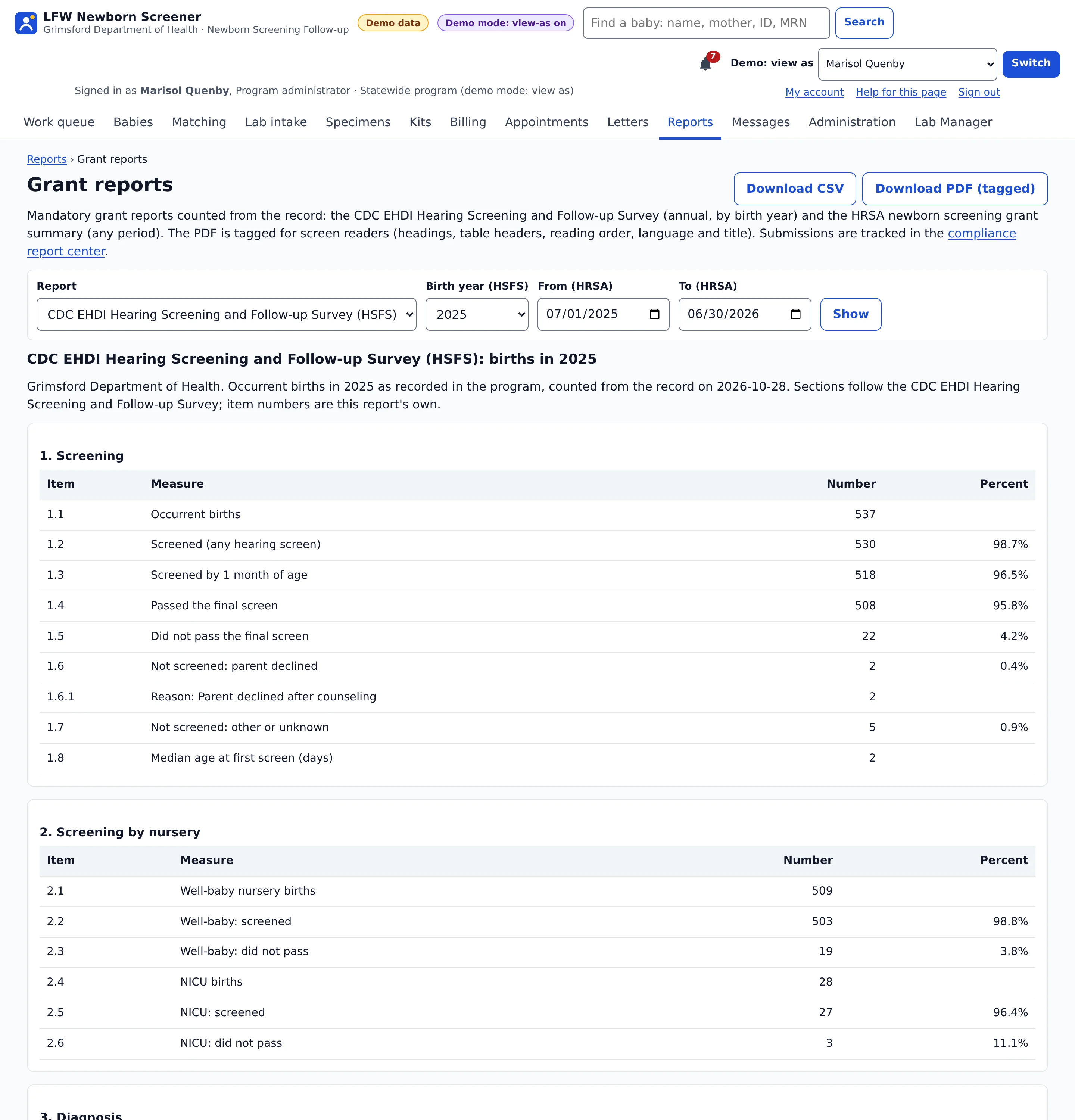

Enlarge to view the full screenshot.
One record per baby.
Each module keeps its own results, care path, outcome and refusal record, on the same baby.
- Four modules Hearing (EHDI), bloodspot, CCHD pulse oximetry and birth defects, with a timeline of screens, diagnoses, letters, notes and messages.
- Vital-records matching Birth certificate files matched by exact rules first, then a weighted score. Twins are told apart by birth order, and doubtful matches wait in an exceptions queue.
- Alerts from results A presumptive positive, borderline or unsatisfactory result raises an alert and starts its care path. Overnight checks flag repeats and diagnoses that have not arrived.
- Care paths without code Steps, due dates and letters per module and disorder, edited by program staff in the browser. Completing a step creates the next task.
- A portal for birth facilities Hospitals enter hearing and CCHD screens or upload device files, and see their missing screens against their births. Audiologists report rescreens and diagnoses.
- Letters, messages and appointments Letters to families and doctors filled from the record, sent by secure email link or fax. Secure messages on the record, and appointments booked from a care path task.
Data in, data out.
Built to replace a program's current system without retyping its history.
- Legacy import STARLIMS-style and e-ScreenerPlus-style follow-up exports and HL7 batch files, with saved column mappings and code crosswalks. A dry run shows exactly what the import would do, and a reconciliation report follows.
- Device feeds Each hearing screener and pulse oximeter gets its own watched folder. Tests are matched to babies and filed by the same rules as manual entry; rows that cannot be filed wait in an error queue.
- A health information exchange Two-way HL7 v2: registrations, demographic changes and results out, demographic updates and hospital screens in. Every message keeps its acknowledgment, failures are retried, and the rest wait in an error queue.
- Early intervention referrals A file to the Part C program, as CSV or HL7 REF^I12, on a schedule. Only referrals with the parent's recorded consent are sent.
- Grant reports The CDC EHDI Hearing Screening and Follow-up Survey and the HRSA newborn screening grant summary, counted from the record, as CSV and a tagged PDF.
- Your own mail relay Email goes through the department's SMTP relay over TLS, with retries and a delivery log. Notices carry no names or health details, only a sign-in link.
How it fits with the other two products.
- LFW Lab Manager: the screening laboratory, in the same database. A released bloodspot result reaches the baby's record and raises its alert at once.
- LFW Newborn Screener: the follow-up program: results, care paths, letters, facilities and reports.
- LFW Referral Tracker: community referrals that a partner closes with what happened.
- On its own: Newborn Screener also takes results by HL7 or file from another laboratory system, so a program can keep its current lab software.
Standards.
- HL7 v2.5.1
- ORU^R01 results in, ADT^A04 and A08 and ORU^R01 out to an exchange with acknowledgments, and REF^I12 referrals to early intervention.
- FHIR R4
- Read and search for Patient, Observation and ServiceRequest, with a CapabilityStatement. Read-only: no create or update.
- LOINC
- On hearing and CCHD results, such as 59418-4 for the post-ductal oxygen saturation of a CCHD screen.
- ICD-10-CM
- Coded diagnoses on hearing, bloodspot, CCHD and birth defects results, with an import of the current code file.
- REST API
- Per-partner keys with scopes, facility limits and rate limits, and an OpenAPI document.
Who sees what.
- Program administrator
- Everything, plus users, configuration and the audit trail.
- Follow-up staff
- All babies, the work queue, matching, lab intake, letters and reports.
- Birth facility
- Babies born at that facility: hearing, bloodspot and CCHD.
- Audiologist
- Babies referred to or screened at that clinic, in the hearing module only.
- Primary care provider
- That practice's own patients.
- Sign-in
- Password and an authenticator code, with lockout and a 15-minute idle timeout, or SAML 2.0 single sign-on through the department's identity provider.
- Audit trail
- Every page view, record view, change, export, sign-in and API call. The database refuses edits or deletions to it.
What it replaces.
A follow-up and surveillance system sold by quote, a separate database for each screening program, and the spreadsheets, faxes and paper logs that connect them.
Try the live demo.
Both products in one demo, for the fictional Grimsford Department of Health. The data is reset every night.
- Follow-up program
- Sign in as the program administrator, follow-up staff for hearing, bloodspot or CCHD, or read-only epidemiology.
- Partners
- Sign in as a birth facility, an audiologist or a primary care provider, and see only their own babies.
- Laboratory
- Sign in as laboratory staff or a laboratory supervisor in LFW Lab Manager.
Access is a personal link, such as lfw.com/demo/grimsford-4821, that opens your own private copy of the demo. Nothing your team enters there is shown to anyone else. Links are sent the same business day.
Where it stands.
A working demo with fictional data. Email, text, fax and partner connections are simulated in it. Live connections to the laboratory, vital records, the exchange and early intervention are set up during implementation. It is not FDA-cleared and not in use by any program.
What it needs.
- Who it is for
- State and territorial newborn screening programs, with their birth facilities, audiologists and primary care practices.
- Your records
- Your program owns its data and can export it at any time.
- Accessibility
- 251 demo pages pass automated axe accessibility checks at desktop and phone widths.
- Release
- A working demo with fictional data, not in production. No program runs it yet.
Name it in your RFP.
When a solicitation asks for a named newborn screening follow-up product, use this name exactly:
LFW Newborn ScreenerPublisher: LFW.com LLC, doing business as LFW.
Ask for a demo or a quote.
Tell us how results, screens and referrals reach your follow-up program today. We reply within one business day.