LFW Public Health Suite

From the lab bench to the family's front door.

Three products on one health record:

  • LFW Lab Manager: the screening lab releases the result
  • LFW Newborn Screener: follow-up sees the alert at once
  • LFW Referral Tracker: every referral is tracked until it closes

For state and local health departments and public health laboratoriesWorking demos with fictional data · three products, built

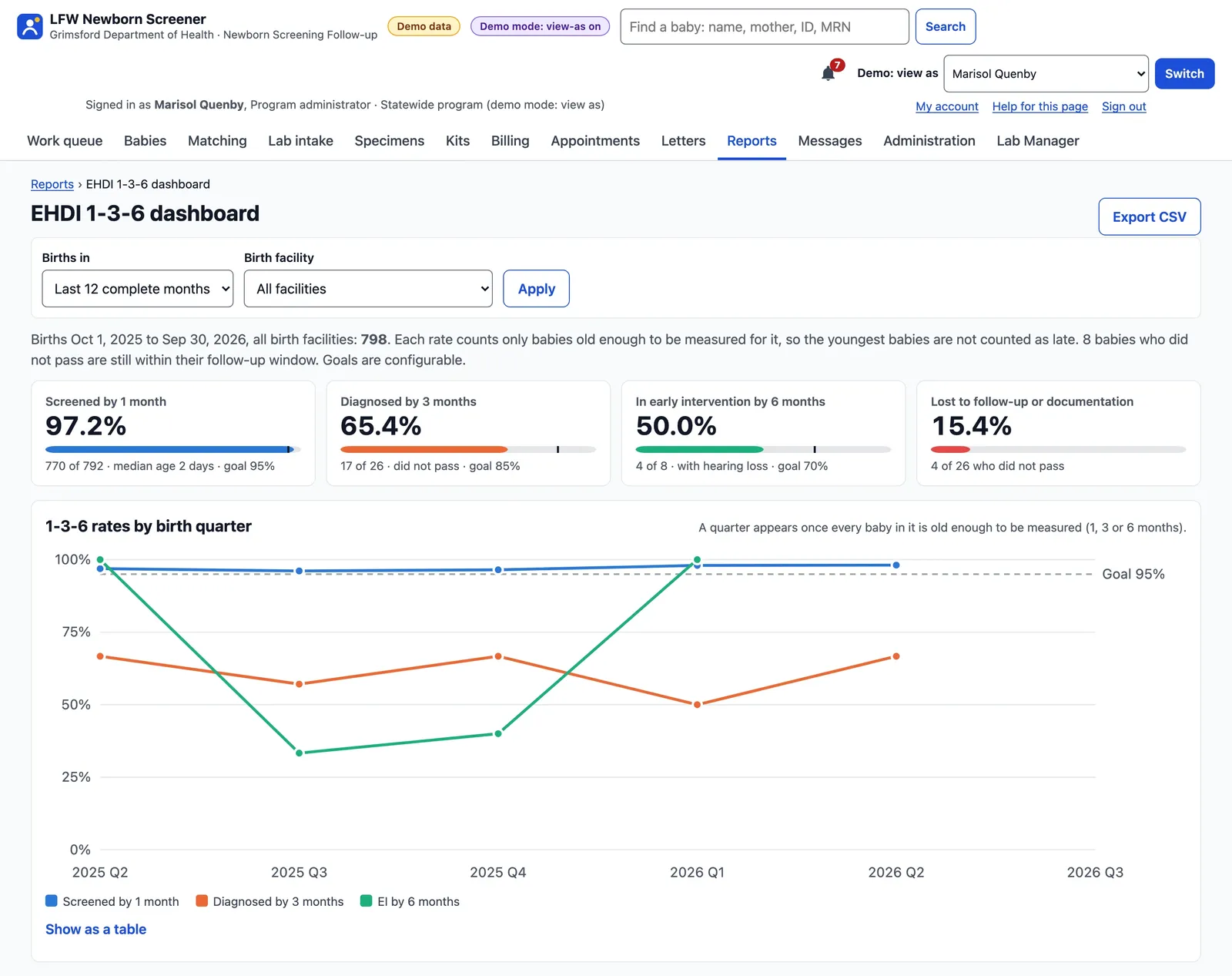
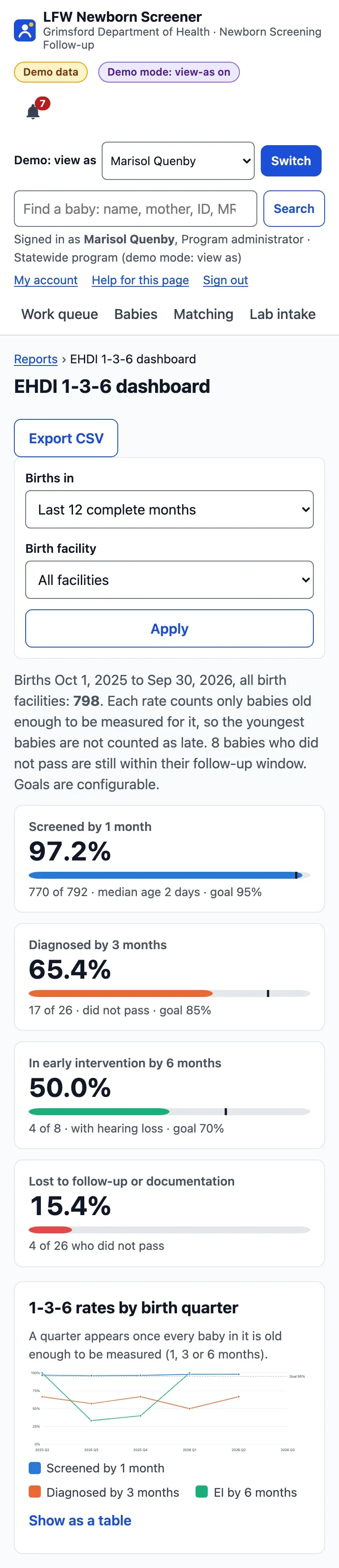
EHDI 1-3-6 dashboard demo for fictional births, with Demo data and demo mode labels: 97.2% screened by 1 month, 65.4% diagnosed by 3 months, 50.0% in early intervention by 6 months and 15.4% lost to follow-up or documentation, each against its goal, and a line chart of the three rates by birth quarter with a 95% goal line.
Fictional department, labeled Demo data.

One baby's first six months.

Each step is in the working demo, with fictional babies, hospitals and families.

  1. Day 1 The hospital screens hearing and CCHD and sends the bloodspot card. Missing screens show on the hospital's own page. Newborn Screener
  2. Day 3 The lab scans the card, matches the hospital's electronic order and puts the specimen on a plate. Lab Manager
  3. Day 5 A presumptive positive needs two different people to sign before release. Release raises the follow-up alert at once. Lab Manager
  4. Month 1 A failed hearing screen moves the baby onto a care path toward diagnosis, with letters to the family and the doctor. Newborn Screener
  5. Month 6 The referral to early intervention is tracked until a partner closes it with what happened. Referral Tracker

Three products on one health record.

Each runs on its own. Together, a result moves from the lab to follow-up to a community partner without a fax or a spreadsheet.

LFW Lab Manager

The newborn screening laboratory, from the card to the released report.

  • Accessioning that matches a scanned card to the hospital's electronic order.
  • Plates, instrument result import and Westgard QC; a run that breaks a rejection rule cannot be accepted.
  • Two different people sign a presumptive positive before release.
  • A results portal where each hospital sees only its own specimens.

Replaces A separate laboratory information system and its interface to follow-up

Read more about LFW Lab Manager
LFW Lab Manager report demo waiting for a supervisor's second sign-off, with Demo data and demo mode labels: a presumptive positive for phenylketonuria (Phe 9.40 mg/dL) with the other seven markers normal, a step bar showing the first sign-off by another analyst, versions and result audit trail panels, the report comments, and a Second sign-off and release form.

LFW Newborn Screener

Follow-up for hearing, bloodspot, CCHD and birth defects, one record per baby.

  • Each module with its own results and care paths, on one baby's record.
  • A portal for birth facilities to enter screens and see their own missing ones.
  • An EHDI 1-3-6 dashboard that counts each rate only for babies old enough to measure.
  • Audiologists and doctors see only the babies and modules they are entitled to.

Replaces Follow-up systems sold by quote, and a database per screening program

Read more about LFW Newborn Screener
A fictional baby's record in the LFW Newborn Screener demo as program staff see it, with Demo data and demo mode labels: four module cards side by side for Hearing (EHDI, diagnosed, with its care path toward early intervention), Bloodspot (resolved normal after an unsatisfactory first specimen, with card images), CCHD pulse oximetry (passed) and Birth defects (none reported).

LFW Referral Tracker

Know what happened to every referral.

  • A tracked link and form for each community partner, built without a developer.
  • Every referral shows where it is, who has it and what came of it.
  • Clinic sign-up pages with time slots and places left.
  • Partners see only the referrals sent to their organization.

Replaces Referral spreadsheets, fax and email between agencies

Read more about LFW Referral Tracker
The Referral Tracker dashboard for a fictional county health department: 120 referrals with 47 still open, a 61% completion rate, a median 12.8 days from sent to closed and 42 overdue, then a chart of referral volume by week with Export CSV.

One record from the lab to the community.

A released result reaches follow-up in the same database, and a referral carries the case to a partner without retyping it.

One person, one record
A baby's specimens, screens, care paths and referrals in one place.
Access by need
Hospitals, audiologists and partners see only what they are entitled to.
One audit log
Every view of health details, every release and every export, with who and when.
Standard formats
HL7 orders and results, CSV, and read-only FHIR in the newborn screening demo.

The LFW platform: your website, forms, sign-in and monitoring. See the platform

LFW Newborn Screener birth facility portal demo for the fictional Grimsford General Hospital, with Demo data and demo mode labels: buttons to enter a screen, upload a device file or register a newborn; last-30-day figures for 18 births, 61% hearing and 78% CCHD screens reported and 0 records with missing fields; and a list of 9 babies missing hearing or CCHD screens with Enter hearing and Enter CCHD buttons.

What the demos show.

4
screening modules on one baby's record: hearing, bloodspot, CCHD and birth defects
2
different people must sign a presumptive positive before it is released
8
first-tier markers configured in the lab demo, with two second-tier tests
1
database for the lab and follow-up, so a release raises the alert at once

Working demonstrations with fictional data. Lab Manager is not validated under CLIA, not FDA-cleared and not in use by any laboratory. Instrument files, hospital orders, HL7 transmissions, email, text and fax are simulated.

Questions health departments ask.

Do we have to take all three?

No. Each product runs on its own. A program can start with follow-up and keep its current laboratory system, or the other way around.

Is Lab Manager ready for a CLIA laboratory?

Not yet. It has not been validated under CLIA, it is not FDA-cleared and no laboratory uses it. Validation is a project we would do with the laboratory.

Does it connect to vital records, EHRs and the HIE?

The demos simulate those connections. HL7 orders and results are built against a simulator; real interfaces are set up with each partner.

Who can see a baby's record?

Program staff see the whole record. A hospital sees its own babies, and an audiologist sees the hearing module only. Every view is logged.

Follow one result with us.

We walk your program and lab staff through one baby, from the card to the referral, in the working demos.